Tonight Wikipedia is scheduled to go down for 24 hours, prompting somewhat of a media frenzy. TIME has, in fact, released an article about "how to survive Wednesday's Wikipedia Blackout". As one of the most popular sites on the internet, Wikipedia is more that just a go-to for information on science, history, and popular culture: it acts as a portal for the international community to share knowledge.
It is no secret that totally love Wikipedia: it is perhaps one of the greatest things the internet has to offer. While there are many sites out there that garner a lot of traffic, like Twitter, Google, and YouTube, Wikipedia is free of advertising and there is no need to sift through junk. The internet revolution has brought democracy to our day-to-day lives in ways that we never could have imagined. This morning I watched a new video about Oscar-winning films that is going viral. After watching this, I thought of how media like this would have been produced and consumed a decade ago. While something like this would have been produced by a major television network and only could have been viewed at scheduled times on the air, it is now created by anyone with vision, ambition, and resources, and can be viewed by virtually anyone, anywhere.
One of the major ramifications of this democratisation movement has been trying to figure out copyright laws. That is, in fact, why Wikipedia is shutting itself down for 24 hours. In the United States (as well as many other jurisdictions), pressures from governments have led to various websites and forms of media to be closed and taken down. Wikipedia's management have termed these attempts to regulate the internet "censorship" and have decided that it is time to raise awareness.
What I find particularly interesting is that censorship legislation has always been framed as affecting filesharing sites (such as the Napster suit from over a decade ago). However, many industries, like publishers, are suffering lower sales as a consequence of sharing information on the internet (think of how Sparks Notes has been effectively replaced by Wikipedia). The influence of these industries on government through lobbying and through sponsorship is immense and not to be taken lightly.
The battle between the regulatory aims of state-corporate partnerships and the democratic people of the internet has been raging for as long as the internet has been a household item. It's truly a battle of capital versus the freedom to share. In the context of personal liberty, or in the interests of building communities of knowledge, the democracy of the internet is something that needs to be vehemently defended.

Is This Progress? This Is Progress.
Tuesday, 17 January 2012

Wednesday, 4 January 2012
People For Good
Last year there were plenty of movements that made some serious ground. As usual there were trends in art and music and all sorts of new internet memes, but what is astonishing to me is the variety of interesting social, economic, and political movements that garnered attention. You've heard me go on about Occupy at length, but there have been others that were pretty significant.
This first to look at is the movements taking place in the Middle East and North Africa this year. Collectively, they have been termed the Arab Spring (in homage to the much less successful Prague Spring of 1968), but these movements became autonomous and locally focused, much in the same grain as Occupy has.
Another movement that was popular last year was of course the Tea Party Movement. Although it started in 2009, the Tea Party really was a force in the last year, particularly with so much attention given to American politics in the run-up to the 2012 election.
There have been plenty others, in fact, which took place all over the world. My list so far is rather western-centric, but populist movements are expanding and, with the power of the internet as an organising tool, becoming far more effective.
The movement which I wanted to focus on in this post is something to which I have given passing mention already: People for Good. This campaign started last year and, thanks to some brilliant advertising, has become quite well-known, at least here in Canada. In principle, the movement is about doing small things to help others. The philosophy is that it not only helps others, but in doing so we make ourselves feel good. I agree. We should be nicer to other people, but I feel that this movement runs pretty shallow.
While I certainly applaud people for doing random acts of kindness, I am weary of this as a revolutionary idea. Moreover, being nice to each other is a pretty effective distraction for dealing with some of our more serious problems in society. Rather than just putting on a face of being nice to others, why shouldn't we actually care about them by rebuilding our society? I find it quite exciting that Occupy and People for Good came out at roughly the same time and that they have been so differently received. It's certainly not astonishing that these movements have sparked opposite reactions. People for Good is a movement that doesn't require us to really change our lives - Occupy actually challenges the status quo. I'm all for high fives and giving up my seat on the bus, but what would be far more effective in my opinion is having a healthcare system that works for everyone and investing in sustainable energy.
Just to provide an example - let's look at some of these recommendations provided by the official website. The one that stuck out most to me was number 21 - "buy a sandwhich for a homeless person". While I fully agree that we should help people who are in difficult places, I think it is ridiculous and unsustainable for homeless people to rely on the niceness of some passersby. Would it not make more sense to invest in better shelters? Why don't we find ways to give them better mental health support? Why not help them if they are struggling with addiction? Why can't we take the time to help them build skills and find employment?
Short term solutions may sound warm and fuzzy, but in the end, People for Good is just a pipe dream for a better future. It's unfortunate that attention that could go toward actually solving some of the rampant social and economic problems in our society often gets easily diverted.
This first to look at is the movements taking place in the Middle East and North Africa this year. Collectively, they have been termed the Arab Spring (in homage to the much less successful Prague Spring of 1968), but these movements became autonomous and locally focused, much in the same grain as Occupy has.
Another movement that was popular last year was of course the Tea Party Movement. Although it started in 2009, the Tea Party really was a force in the last year, particularly with so much attention given to American politics in the run-up to the 2012 election.
There have been plenty others, in fact, which took place all over the world. My list so far is rather western-centric, but populist movements are expanding and, with the power of the internet as an organising tool, becoming far more effective.
The movement which I wanted to focus on in this post is something to which I have given passing mention already: People for Good. This campaign started last year and, thanks to some brilliant advertising, has become quite well-known, at least here in Canada. In principle, the movement is about doing small things to help others. The philosophy is that it not only helps others, but in doing so we make ourselves feel good. I agree. We should be nicer to other people, but I feel that this movement runs pretty shallow.
While I certainly applaud people for doing random acts of kindness, I am weary of this as a revolutionary idea. Moreover, being nice to each other is a pretty effective distraction for dealing with some of our more serious problems in society. Rather than just putting on a face of being nice to others, why shouldn't we actually care about them by rebuilding our society? I find it quite exciting that Occupy and People for Good came out at roughly the same time and that they have been so differently received. It's certainly not astonishing that these movements have sparked opposite reactions. People for Good is a movement that doesn't require us to really change our lives - Occupy actually challenges the status quo. I'm all for high fives and giving up my seat on the bus, but what would be far more effective in my opinion is having a healthcare system that works for everyone and investing in sustainable energy.
Just to provide an example - let's look at some of these recommendations provided by the official website. The one that stuck out most to me was number 21 - "buy a sandwhich for a homeless person". While I fully agree that we should help people who are in difficult places, I think it is ridiculous and unsustainable for homeless people to rely on the niceness of some passersby. Would it not make more sense to invest in better shelters? Why don't we find ways to give them better mental health support? Why not help them if they are struggling with addiction? Why can't we take the time to help them build skills and find employment?
Short term solutions may sound warm and fuzzy, but in the end, People for Good is just a pipe dream for a better future. It's unfortunate that attention that could go toward actually solving some of the rampant social and economic problems in our society often gets easily diverted.
Thursday, 22 December 2011
No Citizenship and Less Immigration
I just finished school a couple weeks ago and since then I have been appalled at the sheer volume of awful things done by the Federal Government, or should I say the Harper Government. The list is long, and I am undoubtedly missing many items, but I'm going to just name some here. Blogs about these topics are bound to come out soon (perhaps in the new year).
Québec wants the Federal Government to transfer to them the data for the long gun registry so that the province can start its own. Harper has refused, leading to what analysts expect to be a very expensive lawsuit
Canada recently pulled out of the Kyoto Protocol. This followed the climate summit in South Africa where Harper reaffirmed Canada's commitment to the environment and to the international community. Leaving the treaty has proven to be an embarrassing move for Canadians.
Harper has suggested that public health care is no longer sustainable in Canada. The Canada Health Act is set to expire in 2014 and Harper hopes to come up with a new agreement with each province, rather than ensuring that the standards are met across the country (which would be in contravention of the Health Act).
December has been a busy month. But one of the most ridiculous items to come up has been the recent decision by the Federal Government to ban the wearing of face coverings for Muslim women at the citizenship ceremonies. I recently wrote a term paper about Islamophobia in Europe, particularly in the context of European citizenship policy. I was very critical of the oppressive stances of national governments (particularly in France) and of the European Union in general. As a result of this research being so fresh, I have a lot to say about Islamophobia in Canada.
In Canada Islamophobia is a growing problem. Our leaders know that debates around terrorism, Islam, immigration, and security are all intertwined in the public's perspective. These controversial issues are always bundled together as a package, with hardly any effort given to unpack the correlation between the ideas. Politicians, religious leaders, media conglomerates, and many others have used fear invoke reactions from Canadians that are hostile to Muslims. It obviously comes as no surprise to me that the government would go to such lengths to ban face coverings, but what's even more interesting is the public reaction.
As anyone who knows me can attest, I am an avid CBC Radio 1 fan, and long trips home are often spent listening to the radio. The day I was in transit to Kitchener happened to be the day after the announcement of the policy, and Ontario Today, a daily call-in show, was having a debate on the issue. What surprised me was that the percentage of callers supporting the move was greater than the percentage of callers who were upset. Since CBC Radio is generally quite a fair and balanced media outlet (often criticised for being too left-wing), this took me by complete surprise. In fact, many who were calling in were self-identified opponents of Harper and still supported the move - evidence that this move is congruent with larger social forces of Islamophobia.
The whole premiss of banning face coverings at a citizenship ceremony bothers me for a wide variety of reasons, not the least of which being that the event is just for show. People who participate in the ceremonies have already been deemed successful candidates for Canadian citizenship.
Also, the government's position was that it needs to be made clear that the person's face is visible as that is how we can tell if they are saying the oath. I find this quite ridiculous - I never had to take an oath of citizenship. Why should I be treated any differently because I had the great fortune of having been born here? The ceremony should be recognised for what it is: a formality.
Moreover, I think it's important to note that by saying women cannot wear face coverings that there is a sense of cultural superiority at play. To Canadians, it is supposed to be objectively "better" that we should see your face. The "Ideal Citizen" or "Ideal Canadian" is someone who looks and acts like a normal person - and since normal is entirely subjective, this means like a secular Christian.
This is similar to the secular policies of France and of Québec. In both regions, a strong civic national identity is represented by the removal of religious icons in public. While lofted as equal and fair, these policies promote secularism that has a distinctly Christian history. Since religion and culture are vastly interwined, it is impossible to have a secular tradition that ignores the influences of religion (look at the farce in the United States for example). Also, note that many of the face coverings are relics of culture long before the arrival of Muhammad, and are therefore not a product of Islam.
It's hard to not see the line of reasoning that Canadians (read: whites) are much more fair to their women than Muslims. Women in the West are supposed to be liberated and free, but this is clearly not the case. It's not a black and white division - both "Western" and "Eastern" women are oppressed, albeit in slightly different ways. Refer to this great political cartoon.
Lastly, when asked if there would be any accommodations, the citizenship and immigration minister, Jason Kenny, indicated that that is a ridiculous idea. His attitude was that this was some type of light topic and that there will be no harm done to anyone, afterall, if new Canadians can't handle us, they can always "choose" to go back home. I encourage you to read the text of the speech made 12 December when announcing the policy.
There are two conclusions that I draw from this policy. Firstly, I believe that this move was designed to distract Canadians from other, more serious, policy issues that have emerged over the past few months. Refer to my list above. As I made mention to, this is a topic to which virtually ALL Canadians can relate. Everyone has an opinion and it's easy to gather and debate this topic (as I have managed to do continuously for at least a week). It keeps us busy and prevents us from getting into debates about items that might require some more research.
Secondly, I feel that this gives credence to a statement one of my classmates made this year about Jason Kenny. He referred to him as our Minister of No Citizenship and Less Immigration. Although this reference was made long before the policy announcement last week, it's really highlighting the fact that the Harper Government is following a sadly predictable trend when it comes to Muslims in our society.
Québec wants the Federal Government to transfer to them the data for the long gun registry so that the province can start its own. Harper has refused, leading to what analysts expect to be a very expensive lawsuit
Canada recently pulled out of the Kyoto Protocol. This followed the climate summit in South Africa where Harper reaffirmed Canada's commitment to the environment and to the international community. Leaving the treaty has proven to be an embarrassing move for Canadians.
Harper has suggested that public health care is no longer sustainable in Canada. The Canada Health Act is set to expire in 2014 and Harper hopes to come up with a new agreement with each province, rather than ensuring that the standards are met across the country (which would be in contravention of the Health Act).
December has been a busy month. But one of the most ridiculous items to come up has been the recent decision by the Federal Government to ban the wearing of face coverings for Muslim women at the citizenship ceremonies. I recently wrote a term paper about Islamophobia in Europe, particularly in the context of European citizenship policy. I was very critical of the oppressive stances of national governments (particularly in France) and of the European Union in general. As a result of this research being so fresh, I have a lot to say about Islamophobia in Canada.
In Canada Islamophobia is a growing problem. Our leaders know that debates around terrorism, Islam, immigration, and security are all intertwined in the public's perspective. These controversial issues are always bundled together as a package, with hardly any effort given to unpack the correlation between the ideas. Politicians, religious leaders, media conglomerates, and many others have used fear invoke reactions from Canadians that are hostile to Muslims. It obviously comes as no surprise to me that the government would go to such lengths to ban face coverings, but what's even more interesting is the public reaction.
As anyone who knows me can attest, I am an avid CBC Radio 1 fan, and long trips home are often spent listening to the radio. The day I was in transit to Kitchener happened to be the day after the announcement of the policy, and Ontario Today, a daily call-in show, was having a debate on the issue. What surprised me was that the percentage of callers supporting the move was greater than the percentage of callers who were upset. Since CBC Radio is generally quite a fair and balanced media outlet (often criticised for being too left-wing), this took me by complete surprise. In fact, many who were calling in were self-identified opponents of Harper and still supported the move - evidence that this move is congruent with larger social forces of Islamophobia.
The whole premiss of banning face coverings at a citizenship ceremony bothers me for a wide variety of reasons, not the least of which being that the event is just for show. People who participate in the ceremonies have already been deemed successful candidates for Canadian citizenship.
Also, the government's position was that it needs to be made clear that the person's face is visible as that is how we can tell if they are saying the oath. I find this quite ridiculous - I never had to take an oath of citizenship. Why should I be treated any differently because I had the great fortune of having been born here? The ceremony should be recognised for what it is: a formality.
Moreover, I think it's important to note that by saying women cannot wear face coverings that there is a sense of cultural superiority at play. To Canadians, it is supposed to be objectively "better" that we should see your face. The "Ideal Citizen" or "Ideal Canadian" is someone who looks and acts like a normal person - and since normal is entirely subjective, this means like a secular Christian.
This is similar to the secular policies of France and of Québec. In both regions, a strong civic national identity is represented by the removal of religious icons in public. While lofted as equal and fair, these policies promote secularism that has a distinctly Christian history. Since religion and culture are vastly interwined, it is impossible to have a secular tradition that ignores the influences of religion (look at the farce in the United States for example). Also, note that many of the face coverings are relics of culture long before the arrival of Muhammad, and are therefore not a product of Islam.
It's hard to not see the line of reasoning that Canadians (read: whites) are much more fair to their women than Muslims. Women in the West are supposed to be liberated and free, but this is clearly not the case. It's not a black and white division - both "Western" and "Eastern" women are oppressed, albeit in slightly different ways. Refer to this great political cartoon.
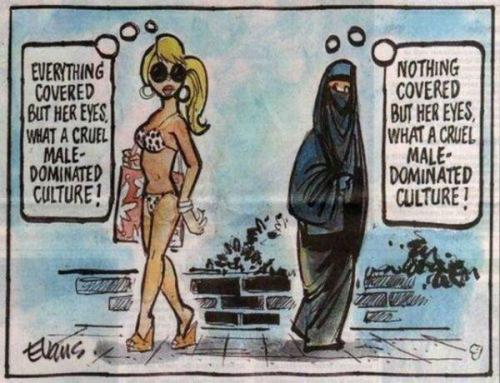
Lastly, when asked if there would be any accommodations, the citizenship and immigration minister, Jason Kenny, indicated that that is a ridiculous idea. His attitude was that this was some type of light topic and that there will be no harm done to anyone, afterall, if new Canadians can't handle us, they can always "choose" to go back home. I encourage you to read the text of the speech made 12 December when announcing the policy.
There are two conclusions that I draw from this policy. Firstly, I believe that this move was designed to distract Canadians from other, more serious, policy issues that have emerged over the past few months. Refer to my list above. As I made mention to, this is a topic to which virtually ALL Canadians can relate. Everyone has an opinion and it's easy to gather and debate this topic (as I have managed to do continuously for at least a week). It keeps us busy and prevents us from getting into debates about items that might require some more research.
Secondly, I feel that this gives credence to a statement one of my classmates made this year about Jason Kenny. He referred to him as our Minister of No Citizenship and Less Immigration. Although this reference was made long before the policy announcement last week, it's really highlighting the fact that the Harper Government is following a sadly predictable trend when it comes to Muslims in our society.
Friday, 9 December 2011
Fun Cars!
We have all seen hundreds of thousands of advertisements just this year alone. Over our lifetime we have been exposed to a number of commercials, posters, telemarketers, flyers, product placements, and many more sinister and sublime marketing techniques. According to one of my favourite authors, Terry O'Reilly, advertising is the greatest art form of the twentieth century.
As someone who is very focused on criticising the assumptions in our modern, Western society, I am fascinated about car culture in North America, I have been thinking a lot lately about what I see as a relatively new trend in advertising automobiles in the past year or so, which I will explain shortly.
Let's put this into historical perspective. Over the past century the car has become symbolic of North America and a lifestyle of choice, prosperity, and hard work. While cars were marketed successfully before the Second World War, it wasn't until the 1950s that the automobile became such a salient representation of North American culture. This was obviously shaped by the massive economic boom fueled by post-war reconstruction, but more importantly, the meteoric rise of cars was made possible by changes brought in by government. As the population of North America began to grow at an unprecedented rate, cities and national governments looked at ways of addressing this concern. Suburbs were the widely adopted solution, favoured by urban planners and politicians, who were influenced by automotive giants in the United States. This came at the expense of public transit and cities that were made to be biked and walked.
It soon became clear that in order to be successful car ownership was necessary. This is particularly interesting when the common attitude is that the car is a status symbol. Very rarely are status symbols necessities in society, so it is something to think about.
While cars were necessary, they needed to be marketed by their respective manufacturers. Advertisements in the 1950s focused on the car as linked to patriotism and freedom, an idea which stuck for the long term. It was not until the 1990s that this emphasis changed. Modern car commercials focused on cars for absolutely everything: rugged trucks, elegant sedans, powerful coupes, and practical family vehicles. Marketers became increasingly more adept at appealing to the markets that they thought would be interested in their cars.
Two concerns became salient in the past 15 years. The first, which came about in the 1990s, was safety. Manufacturers competed with each other for the best safety ratings in their classes. This is best explained by the rapid rise of the Sport Utility Vehicle (for more information check out The Spirit Level). By the mid-2000s the focus had shifted to how fuel efficient their cars were. There are countless examples of commercials that appeal to this, but there has been an attempt by virtually every type of car to make their vehicles more fuel efficient, from trucks to luxury vehicles, to the cross-over.
Now, post-2010 I see the trend of cars becoming fun. Despite the fact that I don't believe what I see in commercials on a general basis, I can see safety and fuel economy as important things you need in a car. However, this is not true of fun. I have never had a lot of fun driving. Whether it is the rush hour traffic jam, the 7-hour road trip, or the slow traverse through a snowstorm late at night, driving is rarely ever fun. Not to mention, having a car means carrying debt, buying insurance, paying for maintenance, and driving people around because you have a car and they don't.
Despite this, marketers, fearing that young people aren't buying cars like in the old days, are targeting youth with sleek ads that make owning a car look really exciting. Oddly enough, the driving isn't really the fun part. Certain makes and models of cars have been marketed as fun, but it was because they are so-called high performance. The cars that are marketed as fun now have no precedent.
Take, for example, the 2012 Cruze. The appeal of this car is the "international" experience. What do young people like doing? Listening to music? Hanging out in urban centres? Eating food from Asia, South America, and the Middle East? Why not have a commercial that shows them doing this, insinuating that these pass-times are congruent with owning a car - but not just any car, the 2012 Chevrolet Cruze. This is evident in its slogan: "Don't just drive, Cruze".
This drives me crazy. It really does. But that's marketing. I assume that once this formula gets tired these commercials will disappear and be replaced with something else. At this point it's impossible to know what, but they will find something to get the attention of the young people that are increasingly "carless".
As someone who is very focused on criticising the assumptions in our modern, Western society, I am fascinated about car culture in North America, I have been thinking a lot lately about what I see as a relatively new trend in advertising automobiles in the past year or so, which I will explain shortly.
Let's put this into historical perspective. Over the past century the car has become symbolic of North America and a lifestyle of choice, prosperity, and hard work. While cars were marketed successfully before the Second World War, it wasn't until the 1950s that the automobile became such a salient representation of North American culture. This was obviously shaped by the massive economic boom fueled by post-war reconstruction, but more importantly, the meteoric rise of cars was made possible by changes brought in by government. As the population of North America began to grow at an unprecedented rate, cities and national governments looked at ways of addressing this concern. Suburbs were the widely adopted solution, favoured by urban planners and politicians, who were influenced by automotive giants in the United States. This came at the expense of public transit and cities that were made to be biked and walked.
It soon became clear that in order to be successful car ownership was necessary. This is particularly interesting when the common attitude is that the car is a status symbol. Very rarely are status symbols necessities in society, so it is something to think about.
While cars were necessary, they needed to be marketed by their respective manufacturers. Advertisements in the 1950s focused on the car as linked to patriotism and freedom, an idea which stuck for the long term. It was not until the 1990s that this emphasis changed. Modern car commercials focused on cars for absolutely everything: rugged trucks, elegant sedans, powerful coupes, and practical family vehicles. Marketers became increasingly more adept at appealing to the markets that they thought would be interested in their cars.
Two concerns became salient in the past 15 years. The first, which came about in the 1990s, was safety. Manufacturers competed with each other for the best safety ratings in their classes. This is best explained by the rapid rise of the Sport Utility Vehicle (for more information check out The Spirit Level). By the mid-2000s the focus had shifted to how fuel efficient their cars were. There are countless examples of commercials that appeal to this, but there has been an attempt by virtually every type of car to make their vehicles more fuel efficient, from trucks to luxury vehicles, to the cross-over.
Now, post-2010 I see the trend of cars becoming fun. Despite the fact that I don't believe what I see in commercials on a general basis, I can see safety and fuel economy as important things you need in a car. However, this is not true of fun. I have never had a lot of fun driving. Whether it is the rush hour traffic jam, the 7-hour road trip, or the slow traverse through a snowstorm late at night, driving is rarely ever fun. Not to mention, having a car means carrying debt, buying insurance, paying for maintenance, and driving people around because you have a car and they don't.
Despite this, marketers, fearing that young people aren't buying cars like in the old days, are targeting youth with sleek ads that make owning a car look really exciting. Oddly enough, the driving isn't really the fun part. Certain makes and models of cars have been marketed as fun, but it was because they are so-called high performance. The cars that are marketed as fun now have no precedent.
Take, for example, the 2012 Cruze. The appeal of this car is the "international" experience. What do young people like doing? Listening to music? Hanging out in urban centres? Eating food from Asia, South America, and the Middle East? Why not have a commercial that shows them doing this, insinuating that these pass-times are congruent with owning a car - but not just any car, the 2012 Chevrolet Cruze. This is evident in its slogan: "Don't just drive, Cruze".
This drives me crazy. It really does. But that's marketing. I assume that once this formula gets tired these commercials will disappear and be replaced with something else. At this point it's impossible to know what, but they will find something to get the attention of the young people that are increasingly "carless".
Thursday, 1 December 2011
Men and Housework
In the past few weeks since Tide released this commercial, I'm certain I've seen it at least twenty times. Over the past few days I've been thinking about if and how this advertisement is actually progressive. Here is a window into the inner dialogue I've been having recently.
What is remarkable about the commercial, and thus why it is appearing in my blog, is that it features a dad doing the laundry. Despite the fact that we allegedly live in some sort of gender equality paradise where stereotyping roles are a vestige of the past, I have seen less than 5 commercials in my life where there is a man doing a household chore such as sweeping the floors, cleaning the shower, or doing the laundry. Obviously by virtue of showing a man doing "woman's" work, this ad really gets your attention. In fact there's a lot of buzz around the internet about how great this commercial is.
That said, I felt uneasy about after a couple times watching it, and it soon dawned on me that it has something to do with the character of the male in the ad. Obviously the dad is gender bending by doing laundry, but he is also cast as effeminate. His speech, his mannerisms, and his close relationship with his daughter all seem to point at the fact that this man is not a man, he's very much feminine.
But then I started thinking about how the commercial was obviously stereotyping male interests and skill. The idea of laundry as "classic problem solving", where efficiency is key, appeals to stereotyped male notions of logic. This is effectively evidenced by the more than 80 per cent of current engineering students in Canada being male despite the majority of university students being female in this country.
This dichotomy (on the one hand classic male intuition; on the other hand a very female domestic role) shows the complexity of gender. The fact that he can't really be characterised as male OR female stands out as a significant benefit of this commercial to me. Often androgyny is painted as very alien, but in this case it's quite accessible (and of course consumer friendly).
After coming to this realisation, I started checking out forums on the internet to see what other people were saying about this commercial. Naturally, there we super-socially-conservative people (both men and women) who characterised this man as homosexual and in derogatory terms. There were others who claimed he was a threat to our ideas of the household division of labour. Many praised the ad for taking on this issue and showing that it is okay for men to do the laundry and be close with their daughters. Google some of the following keywords to get a sense of what's being talked about: tide commercial, gender, braid, problem solving, laundry, dad.
Ultimately, as I'm sure you can tell, I haven't really figured out what I think about Tide's new ad. I think it has already sparked controversy, which is good. Moreover, even though it has generated backlash, it is still being aired. That is a good sign that Tide is not about to back of over a question of values. I hope to hear from some of you and get a sense of your impressions of both the commercial itself and the discourse around it.
What is remarkable about the commercial, and thus why it is appearing in my blog, is that it features a dad doing the laundry. Despite the fact that we allegedly live in some sort of gender equality paradise where stereotyping roles are a vestige of the past, I have seen less than 5 commercials in my life where there is a man doing a household chore such as sweeping the floors, cleaning the shower, or doing the laundry. Obviously by virtue of showing a man doing "woman's" work, this ad really gets your attention. In fact there's a lot of buzz around the internet about how great this commercial is.
That said, I felt uneasy about after a couple times watching it, and it soon dawned on me that it has something to do with the character of the male in the ad. Obviously the dad is gender bending by doing laundry, but he is also cast as effeminate. His speech, his mannerisms, and his close relationship with his daughter all seem to point at the fact that this man is not a man, he's very much feminine.
But then I started thinking about how the commercial was obviously stereotyping male interests and skill. The idea of laundry as "classic problem solving", where efficiency is key, appeals to stereotyped male notions of logic. This is effectively evidenced by the more than 80 per cent of current engineering students in Canada being male despite the majority of university students being female in this country.
This dichotomy (on the one hand classic male intuition; on the other hand a very female domestic role) shows the complexity of gender. The fact that he can't really be characterised as male OR female stands out as a significant benefit of this commercial to me. Often androgyny is painted as very alien, but in this case it's quite accessible (and of course consumer friendly).
After coming to this realisation, I started checking out forums on the internet to see what other people were saying about this commercial. Naturally, there we super-socially-conservative people (both men and women) who characterised this man as homosexual and in derogatory terms. There were others who claimed he was a threat to our ideas of the household division of labour. Many praised the ad for taking on this issue and showing that it is okay for men to do the laundry and be close with their daughters. Google some of the following keywords to get a sense of what's being talked about: tide commercial, gender, braid, problem solving, laundry, dad.
Ultimately, as I'm sure you can tell, I haven't really figured out what I think about Tide's new ad. I think it has already sparked controversy, which is good. Moreover, even though it has generated backlash, it is still being aired. That is a good sign that Tide is not about to back of over a question of values. I hope to hear from some of you and get a sense of your impressions of both the commercial itself and the discourse around it.
Saturday, 12 November 2011
Remembrance
Yesterday I went to the cenotaph in downtown Ottawa to participate in the Remembrance Day ceremonies. Every year since I graduated from high school I have gone to the local gathering. As someone who has had many relatives participate in Canada's armed forces, mostly during the Second World War, I am proud to go and pay my respects to those who gave the ultimate sacrifice.
What I saw this year, however, leaves me feeling pretty uneasy. With the end of Canada's combat mission in Afghanistan this year, this conflict is now a past war and is part of the remembrance of past sacrifices. The role that Canada plays in the Middle East is being normalised by bringing it under the umbrella of the First World War, the Second World War, the Korean War, and various Peacekeeping missions. That is to say that the conflict in Afghanistan is now part of a series of armed conflicts that are to be remembered as part of Canada's commitment to peace.
Of course this is something I find remarkably interesting as an historian. The only conflict where Canada's participation was truly justified was the Second World War - hence its terming "the Good War". That said, even Canada and the allied powers during this conflict engaged in atrocious practices (such as the Japanese Internment, the use of atmoic weapons, and of course the many atrocities committed by Stalin's Red Army during the conquest of Germany and East-Central Europe in 1944-45). But overwhelmingly, the Second World War was necessary to prevent the spread of fascism and tyranny. Japan's Rape of Nanjing and Germany's Holocaust were representative of societies where aggressive militarism and social engineering where normalised to the point where few were comfortable questioning it.
In this conflict it is almost universally accepted that intervention was the right choice. But this is not the same with Afghanistan. Popular opinion polls have shown that the war is highly contentious and controversial. Much of this has to do, in my mind, with the fact that little is really known about the conflict itself. The aims of going there are ambiguous, the enemy is nebulous, and our role is not clearly defined. In fact, many believe it is a straightforward peacekeeping mission. While it is in fact called a peacekeeping mission under the flag of NATO, it is important to differentiate it from a UN peacekeeping mission.
I think it is important to understand my criticism of the aims of war without criticising those who are involved. I believe that the men and women who are fighting overseas are outstanding people and I have a lot of respect for them. One of my favourite radio programmes is "Afghanada", a weekly production about a group of Canadian soldiers fighting in Afghanistan. I support our troops, but what I cannot support is an ideology behind it that is based on following American foreign policy. Imbedded in that is the use of the armed forces for protecting against racialised threats, securitising our borders for the purpose of trade, and intervening in other countries that have the right to determine their own domestic policies.
I will end this entry with a political cartoon I found a couple weeks ago. I was interested in it at the time because of its connections to the Occupy Together Movement; however, it has resonated with me in the weeks since because of the media frenzy around the first remembrance ceremonies since the end of the conflict in Afghanistan. At any rate, I commented on this photo when it came up on my Facebook feed and I posted the following:
"How can you possibly compare these people? The great work of Canadians in fighting oppressive and aggressive imperialism was brave. However, the Canada and the United States of the present have evolved significantly and have now become oppressive and aggressive imperialists. Standing up to our "democratic" and "liberal" governments is also a brave endeavour. Many members of my family served and I am very proud of them, but they are also proud of me for standing up to our corporatist governments"
Something to think about. Something to remember.
What I saw this year, however, leaves me feeling pretty uneasy. With the end of Canada's combat mission in Afghanistan this year, this conflict is now a past war and is part of the remembrance of past sacrifices. The role that Canada plays in the Middle East is being normalised by bringing it under the umbrella of the First World War, the Second World War, the Korean War, and various Peacekeeping missions. That is to say that the conflict in Afghanistan is now part of a series of armed conflicts that are to be remembered as part of Canada's commitment to peace.
Of course this is something I find remarkably interesting as an historian. The only conflict where Canada's participation was truly justified was the Second World War - hence its terming "the Good War". That said, even Canada and the allied powers during this conflict engaged in atrocious practices (such as the Japanese Internment, the use of atmoic weapons, and of course the many atrocities committed by Stalin's Red Army during the conquest of Germany and East-Central Europe in 1944-45). But overwhelmingly, the Second World War was necessary to prevent the spread of fascism and tyranny. Japan's Rape of Nanjing and Germany's Holocaust were representative of societies where aggressive militarism and social engineering where normalised to the point where few were comfortable questioning it.
In this conflict it is almost universally accepted that intervention was the right choice. But this is not the same with Afghanistan. Popular opinion polls have shown that the war is highly contentious and controversial. Much of this has to do, in my mind, with the fact that little is really known about the conflict itself. The aims of going there are ambiguous, the enemy is nebulous, and our role is not clearly defined. In fact, many believe it is a straightforward peacekeeping mission. While it is in fact called a peacekeeping mission under the flag of NATO, it is important to differentiate it from a UN peacekeeping mission.
I think it is important to understand my criticism of the aims of war without criticising those who are involved. I believe that the men and women who are fighting overseas are outstanding people and I have a lot of respect for them. One of my favourite radio programmes is "Afghanada", a weekly production about a group of Canadian soldiers fighting in Afghanistan. I support our troops, but what I cannot support is an ideology behind it that is based on following American foreign policy. Imbedded in that is the use of the armed forces for protecting against racialised threats, securitising our borders for the purpose of trade, and intervening in other countries that have the right to determine their own domestic policies.
I will end this entry with a political cartoon I found a couple weeks ago. I was interested in it at the time because of its connections to the Occupy Together Movement; however, it has resonated with me in the weeks since because of the media frenzy around the first remembrance ceremonies since the end of the conflict in Afghanistan. At any rate, I commented on this photo when it came up on my Facebook feed and I posted the following:

"How can you possibly compare these people? The great work of Canadians in fighting oppressive and aggressive imperialism was brave. However, the Canada and the United States of the present have evolved significantly and have now become oppressive and aggressive imperialists. Standing up to our "democratic" and "liberal" governments is also a brave endeavour. Many members of my family served and I am very proud of them, but they are also proud of me for standing up to our corporatist governments"
Something to think about. Something to remember.
Tuesday, 8 November 2011
Reflection on Occupy Ottawa III
A few days ago I decided to leave the Occupy Ottawa movement. This does not mean I am abandoning the cause - I still agree with the need to occupy and with the need to ask for people to change the channel. I just will not set foot in Confederation Park for the time being.
While my reasons for leaving are mine, I will make a note here that I was not alone in leaving when I did. Let me be very straightforward about this: the reason why I parted ways with my comrades was because of the inability and unwillingness of the camp to address matters of fundamental human rights (see Oxfam's list). I really want to refrain from the details as I feel you can look them up pretty easily on the Facebook page or by reading virtually any paper.
What I find astonishing is that the movement, while painted with broad strokes by the media as monolithic, has become heavily decentralised. Each constituent occupy camp has not only come to its own identity, it has exercised complete autonomy from the rest of the hundreds of movements. I say this to emphasise that my reasons for leaving have all to do with my local camp and not with the broader picture.
As at peace as I am with leaving the group, I have also encountered plenty of "literature" on Occupy Together which has been particularly appalling. Firstly, I read an article in Maclean's which read something like this: since Canada doesn't have the same regulatory and policy problems as the United States, there is no need for the Occupy Movement in Canada. While it is typical of a conservative magazine like Maclean's to paint the issue this way, it is entirely ignorant of the broad socioeconomic inequality in our country and the lack of political will to change it.
This feds directly into my second example - this time from my local daily journal, the Ottawa Citizen. On the front cover this week there were two PhD Students who were expressing solidarity with the Occupy Movement on account of the fact that they were unable to find work since finishing school. It is precisely images like these that make people sympathise with the movement - people that are working hard within the confines of the system who aren't going anywhere. It obviously helps when they are white, male, middle class, well-educated, articulate, and otherwise not a "communist" or a "layabout".
This clashes handily with, for example, the recent death at Occupy Vancouver. With each movement coming into its own identity, it is not surprising that the very acute social and economic climate of Vancouver's Lower East Side has led to the movement being seen in an exceptionally negative light. Instead of being identified with clean young professionals, this movement is associated with drug addiction, violence, mental illness, homelessness, and a variety of other interconnected problems.
Together this is representative of the fall of the Occupy Movement's popularity. Where over the first few weeks approval ratings gradually improved, cresting at nearly 60 per cent according to some polls, the past week has seen the receding tide. And there are obviously some significant reasons for this: the media has left people confused about the purpose of the movement, many of the movements have become havens for negative attention, and plenty of people in the general public are just fed up of being saturated with stories about the same thing.
It is evident that this movement has made an impact, but I am becoming more and more concerned that that this statement has come not from the individuals participating, but from the media and from appendages of the state. I don't know what the future holds for occupiers, but I suspect the battle will be uphill for the long haul. While I may not be participating, I want everyone to know that I am still supporting the messages and that I desperately hope for things to get to a place where I can participate again.
While my reasons for leaving are mine, I will make a note here that I was not alone in leaving when I did. Let me be very straightforward about this: the reason why I parted ways with my comrades was because of the inability and unwillingness of the camp to address matters of fundamental human rights (see Oxfam's list). I really want to refrain from the details as I feel you can look them up pretty easily on the Facebook page or by reading virtually any paper.
What I find astonishing is that the movement, while painted with broad strokes by the media as monolithic, has become heavily decentralised. Each constituent occupy camp has not only come to its own identity, it has exercised complete autonomy from the rest of the hundreds of movements. I say this to emphasise that my reasons for leaving have all to do with my local camp and not with the broader picture.
As at peace as I am with leaving the group, I have also encountered plenty of "literature" on Occupy Together which has been particularly appalling. Firstly, I read an article in Maclean's which read something like this: since Canada doesn't have the same regulatory and policy problems as the United States, there is no need for the Occupy Movement in Canada. While it is typical of a conservative magazine like Maclean's to paint the issue this way, it is entirely ignorant of the broad socioeconomic inequality in our country and the lack of political will to change it.
This feds directly into my second example - this time from my local daily journal, the Ottawa Citizen. On the front cover this week there were two PhD Students who were expressing solidarity with the Occupy Movement on account of the fact that they were unable to find work since finishing school. It is precisely images like these that make people sympathise with the movement - people that are working hard within the confines of the system who aren't going anywhere. It obviously helps when they are white, male, middle class, well-educated, articulate, and otherwise not a "communist" or a "layabout".
This clashes handily with, for example, the recent death at Occupy Vancouver. With each movement coming into its own identity, it is not surprising that the very acute social and economic climate of Vancouver's Lower East Side has led to the movement being seen in an exceptionally negative light. Instead of being identified with clean young professionals, this movement is associated with drug addiction, violence, mental illness, homelessness, and a variety of other interconnected problems.
Together this is representative of the fall of the Occupy Movement's popularity. Where over the first few weeks approval ratings gradually improved, cresting at nearly 60 per cent according to some polls, the past week has seen the receding tide. And there are obviously some significant reasons for this: the media has left people confused about the purpose of the movement, many of the movements have become havens for negative attention, and plenty of people in the general public are just fed up of being saturated with stories about the same thing.
It is evident that this movement has made an impact, but I am becoming more and more concerned that that this statement has come not from the individuals participating, but from the media and from appendages of the state. I don't know what the future holds for occupiers, but I suspect the battle will be uphill for the long haul. While I may not be participating, I want everyone to know that I am still supporting the messages and that I desperately hope for things to get to a place where I can participate again.
Subscribe to:
Posts (Atom)